How to Solve a Multi-Layered Cryptic Clue
Not every cryptic clue uses a single trick. Learn how deletion, containers, initial letters, and alphabet wordplay combine in one real puzzle.
The Clue
Some of the most satisfying cryptic clues are the ones that layer several wordplay techniques into a single, smooth-reading sentence. They look impossible at first, but once you peel back each layer, the answer clicks into place beautifully.
Here is a real clue that does exactly that:
Reading this clue naturally, you might picture someone losing confidence in a UFO conspiracy story. That vivid surface reading is exactly what the setter wants you to see. Underneath it, four different wordplay devices are working together to spell out the answer. Let's break them down one at a time.
Step-by-Step Breakdown
Step 1 — Spot the Definition: "hoax"
In almost every cryptic clue, the straight definition sits at the very beginning or the very end. Here the last word, "hoax", is the definition. A bluff is a deceptive act — another word for a hoax. That gives us our target answer: BLUFF.
Once you have a candidate answer, the job is to confirm it by showing that the wordplay produces the same five letters. Let's work through the rest of the clue from right to left.
Step 2 — "UFO crop circle" (Deletion)
This fragment contains a neat deletion. The word "crop" is a deletion indicator — to crop something is to cut it away. What are we cropping? The word "circle", which is being cropped from "UFO".
In cryptic crosswords, the letter O is a classic stand-in for "circle" because an O is circular. So "crop circle from UFO" means: remove the letter O from UFO.
UFO − O = UF
Step 3 — "starts to lose faith" (Initial Letters)
The phrase "starts to" is an initial-letters indicator. It tells you to take the first letter of each word that follows. The words that follow are "lose faith":
- Lose → L
- Faith → F
This gives us the letters LF.
Step 4 — "about" (Container)
The word "about" is a container indicator. It tells you that one piece of the wordplay wraps around another. In this clue, the letters from Step 3 (LF) go about — that is, around — the letters from Step 2 (UF):
L(UF)F → LUFF
The L and F sit on the outside, with UF tucked inside. This gives us LUFF.
Step 5 — "A follower" (Alphabet Trick)
We have LUFF so far, and we need a five-letter word. The remaining fragment is "A follower" at the very start of the clue.
This is not about a person who follows something. Read it literally: A follower means "the letter that follows A" in the alphabet. The letter after A is B.
Place B in front of LUFF:
B + LUFF = BLUFF
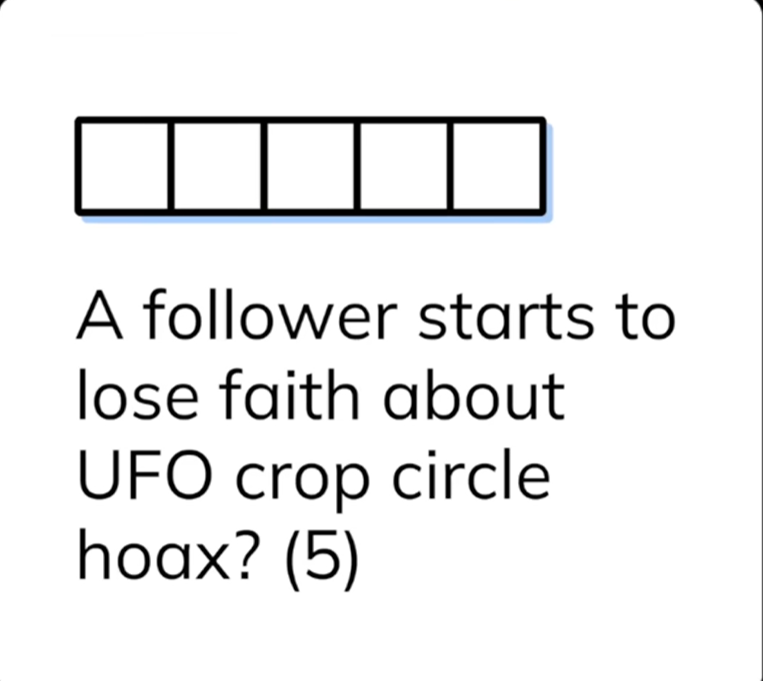
A follower = B | starts to lose faith = LF | about = container | UFO crop circle = UF
B + L(UF)F = BLUFF = hoax
Techniques Used in This Clue
This single clue packs four distinct wordplay devices into just ten words. Here's a quick reference for each one.
Deletion
A deletion indicator tells you to remove letters from a word or abbreviation. In this clue, "crop" tells you to delete O (circle) from UFO. Common deletion indicators: crop, cut, drop, lose, without, missing, remove, shed, trim, less.
Container
A container indicator means one group of letters wraps around another. Here, "about" signals that LF goes around UF to make LUFF. Common container indicators: about, around, outside, holding, containing, embracing, clutching, swallowing, housing.
Initial Letters
An initial-letters indicator tells you to take the first letter of each subsequent word. "Starts to lose faith" gives L and F. Common indicators: starts, initially, first of, heads of, leaders of, opening, at the front of, tops of.
Alphabet Reference
Setters sometimes clue a single letter by its position in the alphabet. "A follower" = B. "Precedes D" = C. "The first" = A. This device is subtle and easy to miss, but it appears regularly in charade-style clues where individual letters are assembled one by one.
Tips for Tackling Complex Clues
- Start from the edges. The straight definition is almost always the first or last word (or phrase) in the clue. Identify it first to give yourself a target answer — or at least a category to work with.
- Scan for indicator words. Words like "about", "broken", "starts to", "crop", and "back" are signposts. Each one points to a specific operation. The more indicators you can spot, the clearer the clue's structure becomes.
- Work in chunks. Don't try to parse the entire clue at once. Isolate small fragments, figure out what letters each one contributes, and then assemble them. Multi-layered clues are puzzles within puzzles — solve the small pieces first.
- Reverse-engineer when stuck. If you have a strong guess for the answer (from the definition and the letter count), work backwards. Can you see how the answer's letters could be built from the wordplay? Sometimes confirming an answer is easier than constructing it from scratch.
Frequently Asked Questions
A multi-layered cryptic clue uses more than one wordplay technique in a single clue. Instead of relying on just an anagram or a hidden word, the setter combines devices like deletion, containers, initial letters, and charades so that you must unravel several operations to reach the answer.
A deletion indicator is a word that tells you to remove one or more letters from another word. Common deletion indicators include "crop", "cut", "drop", "lose", "without", "missing", and "remove". For example, "crop circle from UFO" means remove the letter O (circle) from UFO, leaving UF.
"About" is a container indicator. It tells you that one set of letters goes around another. If a clue says "AB about CD", the result is ACDB — AB wraps around CD. Other common container indicators include "around", "outside", "containing", "holding", and "embracing".
Setters can clue a single letter by referring to its position in the alphabet. "A follower" means the letter B (the letter that follows A). "Predecessor of D" means C. "Leader of France" means F (the first letter). These compact devices are common in charade-style clues where individual letters are assembled piece by piece.
In cryptic crosswords, the letter O is often represented by words that describe circular shapes — "circle", "ring", "zero", "duck" (cricket term for zero), "love" (tennis term for zero), and "nothing". This convention is widely used and worth memorising.
Start from the ends of the clue to locate the definition. Then scan for indicator words to identify the wordplay devices being used. Work through each operation one at a time. If you get stuck, try guessing the answer from the definition and letter count, then reverse-engineer the wordplay to confirm it.
Put These Techniques Into Practice
Solve a new cryptic clue every day with Minute Cryptic. Each puzzle comes with hints and a full explanation to build your skills one clue at a time.
Play Today's Clue