How Cryptic Clues Work: A Complete Breakdown
Understand the anatomy of a cryptic clue, learn to spot clue types, and start solving with confidence.
Breaking Down a Cryptic Clue: A Worked Example
Let's start with a real cryptic clue and take it apart piece by piece. This is the fastest way to understand how cryptic clues actually work.
At first glance, this reads like a simple phrase — something that means a short amount of time. But in a cryptic clue, nothing is what it seems on the surface. The setter is deliberately using the natural reading to disguise the real structure.
Here's how it actually works:
- "Very little" — this is the first definition. Something that is minute (pronounced my-NEWT) means extremely small or tiny.
- "time" — this is the second definition. A minute (pronounced MIN-it) is a unit of time.
Both halves of the clue independently point to the same word: MINUTE. The clue works because MINUTE has two completely different meanings depending on how you pronounce it. The setter has stitched these two definitions together into a phrase that reads naturally, hiding the fact that it's really two separate clues in one.
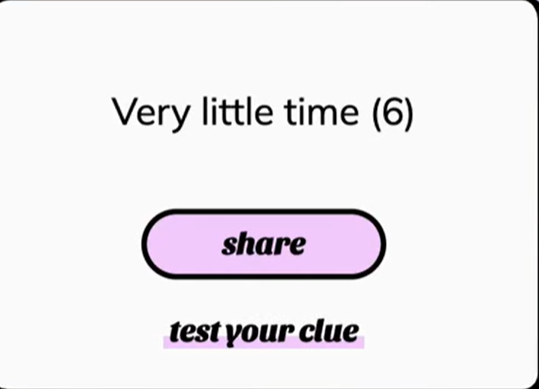
This type of clue is called a double definition — one of the most common and elegant cryptic clue types. Once you learn to spot them, you'll find they're often the quickest clues to solve in any cryptic crossword.
What Is a Double Definition?
A double definition is a cryptic clue that contains exactly two definitions of the answer, placed side by side with no extra wordplay. The challenge is that the setter disguises the boundary between the two definitions so the clue reads like a single phrase or sentence.
Double definitions exploit words that have multiple unrelated meanings. English is full of these — words like BANK (river bank / financial bank), LIGHT (not heavy / illumination), or MATCH (a game / a fire starter).
More Double Definition Examples
The beauty of double definitions is their simplicity. There are no anagram indicators, no hidden letters, no containers — just two meanings colliding in a deceptively smooth phrase. They reward vocabulary breadth and the ability to think about words from multiple angles.
How to Identify the Clue Type
Every cryptic clue (with rare exceptions) contains two things: a straight definition of the answer and some form of wordplay that leads to the same answer. Your first job as a solver is to figure out which part is which.
Here's a four-step method that works for any cryptic clue:
- Find the definition. It's almost always at the very beginning or the very end of the clue. Read the first word or two — could that be a definition of something? Then read the last word or two. One of these is your definition.
- Look for indicator words. Certain words signal specific clue types. Words like "broken," "mixed," or "crazy" suggest an anagram. Words like "in," "within," or "part of" suggest a hidden word. Words like "back," "returning," or "up" (in down clues) suggest a reversal. If you spot an indicator, you've likely identified the clue type.
- Check the letter count. The number in parentheses tells you how many letters the answer has. Use this to confirm or eliminate possibilities. If the clue says (6) and you've found an anagram of six letters in the clue, you're probably on the right track.
- Test your answer. A correct answer must satisfy both the definition and the wordplay. If it only fits one, keep looking. The answer should click into place from both directions — that satisfying "aha!" moment is how you know you've cracked it.
What Makes a Cryptic Clue Work
A well-crafted cryptic clue balances two opposing forces: fairness and misdirection.
Fairness
Every cryptic clue must play by the rules. The definition must genuinely define the answer. The wordplay must logically produce the answer's letters. Every word in the clue must serve a purpose — either as part of the definition, part of the wordplay, or as a linking word between the two. There should be no filler, no wasted words. A solver who understands the conventions should be able to work out the answer through logic alone.
Misdirection
At the same time, the clue's surface reading — the story it seems to tell when you read it as a normal sentence — should lead you away from the answer. The best cryptic clues paint a vivid picture that has absolutely nothing to do with the actual answer. This is the art of the craft: making the clue simultaneously fair and misleading.
Consider this clue:
This legendary clue demonstrates the principle perfectly. It's completely fair — the letters of EGGS are visibly scrambled — but the misdirection is total. You'd never read "Gegs" and think "scrambled" unless you understood how cryptic clues work.