Cryptic Clue Solved: Homograph Misdirection With "Tears, Tears, Tears"
When the same word appears three times with two different meanings, the surface reading becomes a masterclass in cryptic deception.
The Clue
Cryptic setters love words that are spelled the same but mean completely different things. These words — called homographs — let the setter build a convincing surface story while hiding entirely different wordplay underneath. Today's clue is a brilliant example.
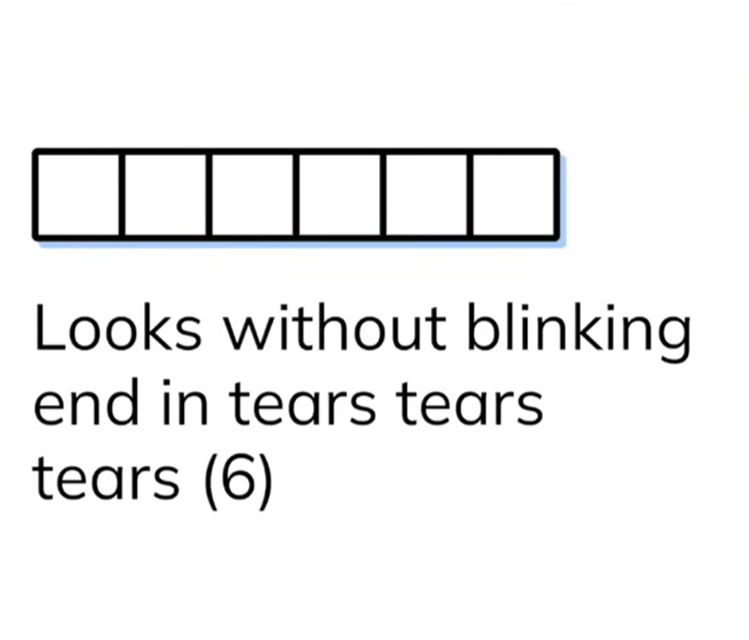
Read the clue naturally and you picture someone staring so long that their eyes water — tears streaming down their face. That image is factually true and emotionally vivid, which is exactly why it's such effective misdirection. The real mechanics have nothing to do with crying at all.
The key insight? At least one of those "tears" isn't pronounced teerz (as in crying). It's pronounced tairz (as in ripping). Once you make that mental switch, the entire clue opens up.
The Homograph Trick: "Tears" vs "Tears"
Before we break down the wordplay, let's be clear about what makes this clue so deceptive. The word "tears" has two completely unrelated meanings:
tears /tɪərz/ — drops of water from the eyes; crying
tears /tɛərz/ — rips apart; pulls to pieces
The surface reading uses the first pronunciation — crying. The wordplay uses the second — ripping. This is homograph misdirection at its finest: the setter never has to do anything unusual with the spelling. The word just looks the same, and your brain fills in the wrong pronunciation.
Homograph misdirection is one of those techniques you recognise instantly once you've seen it. And after today, you'll never read "tears" in a cryptic clue the same way again.
Step-by-Step Breakdown
Step 1 — Spot the Definition: "Looks without blinking"
The straight definition sits at the start of this clue. "Looks without blinking" describes the act of staring — and that gives us our answer: STARES.
Notice how the definition blends seamlessly into the surface story about crying. If you look without blinking for too long, your eyes will indeed water. This is what makes the misdirection so effective — the definition is the setup for the misleading image.
Step 2 — "end in tears" (End Letter)
The phrase "end in tears" is an end-letter indicator. "End in" tells you to take the last letter of the word that follows — in this case, tears.
The last letter of TEARS is S.
Step 3 — "tears tears" (Anagram)
Now we reach the heart of the clue — and the homograph trick. The remaining two words are "tears tears". Here, each "tears" plays a different role:
- The first "tears" is the anagram fodder — the raw letters T, E, A, R, S that will be rearranged.
- The second "tears" (pronounced tairz) is the anagram indicator. To tear something is to rip it apart, to destroy its original form — exactly what an anagram does to a word's letter order.
So we take the letters of TEARS and rearrange them. Combined with the S from Step 2:
S + (T, E, A, R, S rearranged) → S + TARE S... → STARES
Wait — let's be precise. The S from "end in tears" goes first, then the anagrammed letters of TEARS follow. Rearranging T, E, A, R, S after the leading S gives us:
S + TARES = STARES
end in tears = S | tears = T,E,A,R,S (fodder) | tears = anagram indicator
S + TARES = STARES = looks without blinking
Why This Clue Is Special
One Word, Three Roles
The word "tears" appears three times, and each instance does something different:
- First "tears" — provides a single letter (S, from "end in tears")
- Second "tears" — provides five letters of anagram fodder (T, E, A, R, S)
- Third "tears" — acts as the anagram indicator (tears = rips apart)
This triple use of one word is rare and audacious. The repetition actually strengthens the surface reading — "tears, tears, tears" sounds like someone emphasising how much crying there is. You'd never suspect each repetition is doing something mechanically different.
The Surface Tells a True Story
Here's the cleverest part: the surface reading is factually accurate. If you stare without blinking, your eyes really will end up in tears. The definition ("looks without blinking") and the misdirection (crying) are causally linked. This makes it almost impossible to see past the surface meaning on first reading, because your brain accepts it as a logical, complete sentence.
Techniques Used in This Clue
Homograph Misdirection
Using a word that is spelled identically but has different meanings (and sometimes different pronunciations) to mislead the solver. Classic cryptic homographs include: "tears" (crying/ripping), "flower" (plant/something that flows), "lead" (metal/to guide), "bow" (weapon/to bend), and "minute" (time/tiny).
End Letter
Taking the last letter of a word. Indicated by "end in", "end of", "finally", "at last", "ultimately", "tail of", or "conclusion of". In this clue, "end in tears" gives S.
Anagram
Rearranging letters to form a new word. Here, "tears" (ripping) serves as the anagram indicator while another "tears" provides the fodder letters. Common anagram indicators: words implying disorder, destruction, or change — "broken", "wild", "crazy", "mixed", "drunk", "ruined", "scattered".
Homographs Every Solver Should Know
Once you start looking for them, homographs are everywhere in cryptic crosswords. Here are the ones that appear most frequently:
- FLOWER — a plant / something that flows (a river). "Flower" meaning river is a legendary cryptic trick.
- TEARS — crying / ripping. As we've just seen, this word can serve as both anagram fodder and indicator.
- LEAD — the metal Pb / to guide. Often used to misdirect between chemistry and direction.
- BOW — a weapon / to bend / the front of a ship. Three meanings, three possible misdirections.
- MINUTE — a unit of time / extremely small. A classic double definition word.
- WOUND — an injury / past tense of "wind". "Wound up" can mean either injured or coiled.
- ROW — a line / an argument / to paddle. Three meanings that setters love to mix.
Frequently Asked Questions
A homograph is a word that is spelled the same as another word but has a different meaning and sometimes a different pronunciation. In cryptic clues, setters exploit homographs to misdirect solvers. For example, "tears" can mean crying (teerz) or ripping (tairz). The surface reading suggests one meaning while the wordplay uses the other.
"End in" tells you to take the last letter of the word that follows. "End in tears" means the final letter of TEARS, which is S. Similar indicators include "finally", "at last", "tail of", "back of", and "conclusion of".
Yes. This is one of the most playful tricks in cryptic setting. In this clue, the word "tears" appears three times: once as fodder for "end in" (taking the last letter S), once as anagram fodder (the letters T-E-A-R-S), and once as the anagram indicator (tears meaning to rip apart).
When pronounced as "tairz" (to rip), "tears" implies destruction or disorder — exactly what an anagram indicator needs to convey. It tells you to rearrange letters, just as tearing something apart scatters its pieces. Other destructive anagram indicators include "breaks", "smashes", "ruins", and "wrecks".
An end letter indicator tells you to take the last letter of a word. Common indicators include "end of", "end in", "finally", "at last", "ultimately", "tail of", and "conclusion of". For instance, "end in tears" gives S, and "finally happy" gives Y.
Misdirection is the art that makes cryptic clues challenging and entertaining. The surface reading — what the clue seems to say as a normal sentence — deliberately leads you away from the answer. A great cryptic clue is both completely fair (every word serves a logical purpose) and thoroughly misleading (the overall sentence suggests something entirely different from the answer).
Sharpen Your Cryptic Eye
Solve a new cryptic clue every day with Minute Cryptic. Each puzzle comes with progressive hints and a full explanation to help you spot misdirection faster.
Play Today's Clue