Cryptic Clue Solved: When Deletion Meets Anagram
A worked example showing how face letters, deletion, and anagram wordplay chain together in one beautifully deceptive clue.
The Clue
The best cryptic clues do two things at once: they tell a vivid, believable story on the surface while hiding an entirely different logical puzzle underneath. Today's clue is a perfect example — a humorous image of a gorilla with an allergic reaction that conceals a tight chain of wordplay operations.
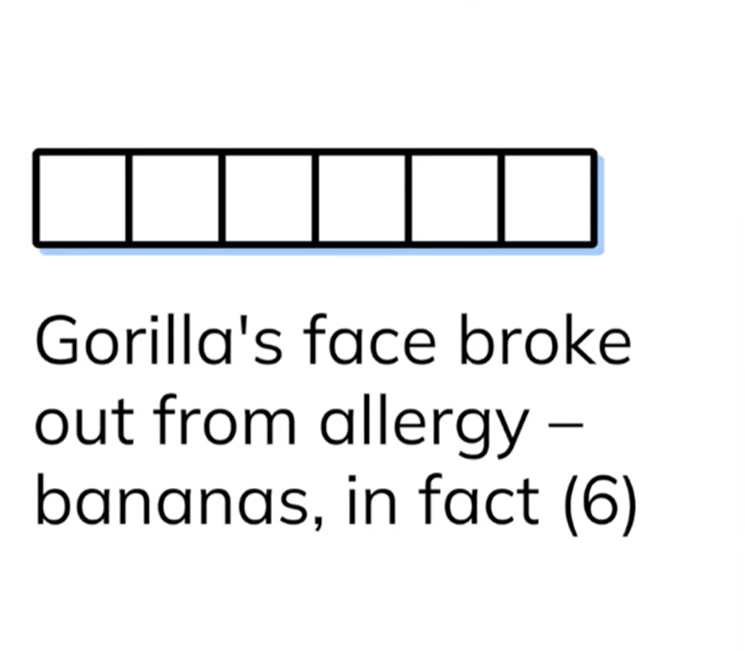
On the surface, you might picture a gorilla breaking out in hives after eating something it shouldn't have. That playful image is deliberate misdirection. The actual mechanics involve three wordplay steps feeding into each other: a face letter, a deletion, and an anagram. Let's unpack each one.
Step-by-Step Breakdown
Step 1 — "Gorilla's face" (Face Letter)
In cryptic crosswords, the "face" of a word is its first letter — the letter you see first, the letter that faces you. So "gorilla's face" gives us the letter G.
This is a common device. You'll also see it as "head of", "top of", "front of", or "opening of" — all meaning the first letter of the word that follows.
Step 2 — "broke out from allergy" (Deletion)
Next, the clue says that the G "broke out from allergy". On the surface, "broke out" sounds like a rash — perfectly matching the allergy theme. But in cryptic language, "broke out from" is a deletion indicator. It means the letter G escapes from (is removed from) the word ALLERGY.
Remove the G from ALLERGY:
ALLERGY − G = A, L, L, E, R, Y
We're left with six letters: A, L, L, E, R, Y. Notice that the setter has buried the raw material for the answer inside a perfectly innocent word. You'd never look at "allergy" and think it contained the answer — which is exactly the point.
Step 3 — "bananas" (Anagram Indicator)
The word "bananas" isn't describing fruit. In cryptic crosswords, "bananas" means crazy — and crazy means the letters need to be rearranged. It's an anagram indicator.
So we take our six letters from Step 2 — A, L, L, E, R, Y — and rearrange them:
A, L, L, E, R, Y → REALLY
Step 4 — "in fact" (Definition)
The final piece is the straight definition, sitting right at the end of the clue: "in fact". And REALLY is indeed another way of saying "in fact". The definition confirms our answer.
Gorilla's face = G | broke out from allergy = ALLERGY − G = ALLERY | bananas = anagram
ALLERY → REALLY = in fact
Why This Clue Works So Well
The Surface Reading
Great cryptic clues read like natural sentences. This one paints a funny, memorable picture: a gorilla whose face breaks out in a rash from an allergy. The dash before "bananas, in fact" even feels like a casual aside — as if the speaker is clarifying what caused the reaction. Every word pulls double duty, serving both the surface story and the cryptic machinery underneath.
This is what experienced solvers call a smooth surface. No word feels forced or out of place. When a clue achieves this while maintaining airtight wordplay, it's a sign of skilled clue-setting.
The Wordplay Chain
The wordplay here is a clean three-step chain:
- Extract a letter (G from "gorilla's face")
- Delete that letter from a word (G from ALLERGY)
- Anagram the remaining letters (ALLERY → REALLY)
Each step feeds into the next. The output of one operation becomes the input for the next. This cascading structure is common in complex cryptic clues, and once you learn to recognise it, you can tackle even the most intimidating-looking puzzles by working through them one operation at a time.
Techniques Used in This Clue
Face Letter (Initial Letter)
Taking the first letter of a word. Indicated by "face", "head", "top", "front", "opening", "start", or "initially". In this clue, "gorilla's face" = G.
Deletion
Removing one or more letters from a word. Indicated by "broke out from", "escaped", "left", "without", "missing", "removed", "dropped", or "lost". Here, G is removed from ALLERGY to leave ALLERY.
Anagram
Rearranging letters to form a new word. Indicated by words suggesting disorder: "bananas", "crazy", "wild", "broken", "mixed", "drunk", "scattered", "ruined", "damaged", or "destroyed". Here, ALLERY is rearranged into REALLY.
How to Spot Deletion-Anagram Combos
Deletion followed by anagram is one of the most elegant patterns in cryptic crosswords. Here's how to recognise it:
- Look for an anagram indicator — a word suggesting chaos or rearrangement. If you find one, the letters to anagram must be somewhere in the clue.
- Count the letters. If a nearby word has more letters than the answer requires, a deletion is probably involved. In this clue, ALLERGY has 7 letters but the answer needs only 6 — one letter must be removed first.
- Find the deletion indicator. A word like "without", "losing", or "broke out from" will tell you which letter or letters to remove before anagramming.
- Verify with the definition. Rearrange the remaining letters. If the result matches the definition at the start or end of the clue, you've cracked it.
Frequently Asked Questions
A face letter is the first letter of a word. In cryptic clues, phrases like "gorilla's face" or "face of danger" tell you to take the opening letter of that word — G for gorilla, D for danger. It is a compact way for setters to clue a single letter.
A deletion indicator tells you to remove one or more letters from a word. Words like "broke out from", "escaped", "left", "without", "missing", and "dropped" all signal that something should be taken away. For example, "G broke out from ALLERGY" means remove G to get ALLERY.
An anagram indicator is a word that signals the letters of a nearby word or phrase need to be rearranged. Common indicators include "bananas", "crazy", "broken", "mixed", "wild", "drunk", "scrambled", and "destroyed" — anything that suggests disorder or rearrangement.
Yes. Many cryptic clues chain multiple wordplay devices together. A common pattern is to first remove a letter from a word (deletion), then rearrange the remaining letters (anagram). This clue does exactly that: remove G from ALLERGY, then anagram ALLERY to get REALLY.
"Bananas" is slang for crazy or wild, which implies disorder. In cryptic crosswords, any word suggesting that something is mixed up, out of order, or chaotic can serve as an anagram indicator. "Bananas" is a popular choice because it reads naturally in surface sentences.
The definition is almost always at the very beginning or the very end of the clue. Read the first word or two and the last word or two — one of these will be a synonym of the answer. In this example, "in fact" at the end is the definition for REALLY.
Ready for More?
Challenge yourself with a new cryptic clue every day. Each Minute Cryptic puzzle comes with progressive hints and a full explanation.
Play Today's Clue